The Echo That Changed Everything
In 1972 the rock n roll itch hit me for good. One Saturday late afternoon I was throwing a football with a friend in a gravel parking lot below the two-story apartment when I heard the Echo that changed my life forever.
A grinding guitar and a vocal with harmonies bouncing off the walls of the factory next door. The Raspberries, playing Go All The Way at the WIXY-1260 appreciation day concert at Edgewater Park. I was so hooked.
They became my all-time favorite band, and I soon knew who played lead for them — Wally Bryson.
But the music had been getting me into trouble long before that.
Learning With What I Had
Christmas 1964. Earlier that year The Beatles appeared on The Ed Sullivan Show, and the world was still excited about this new music. The youngest of the Stadler family loved anything to do with music.
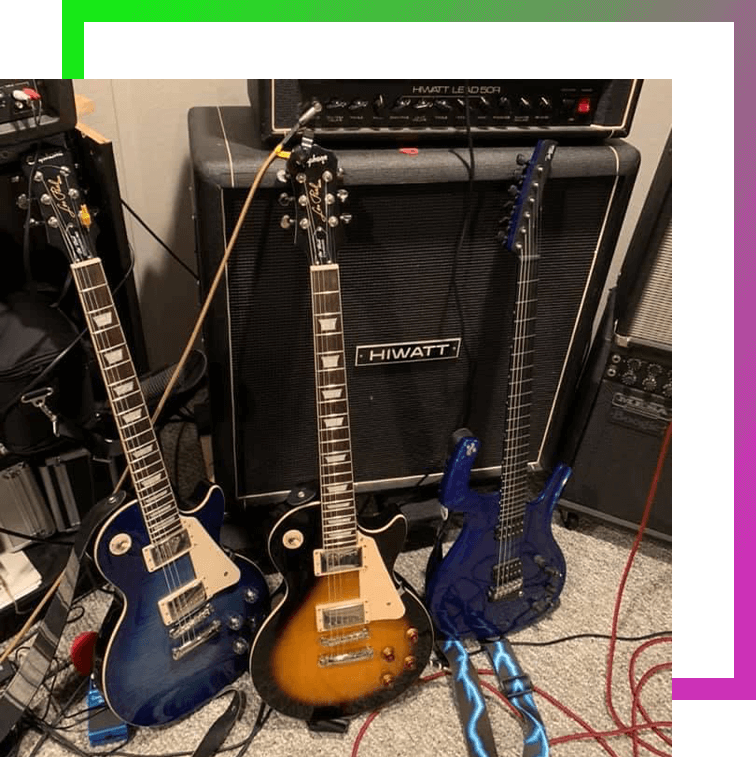
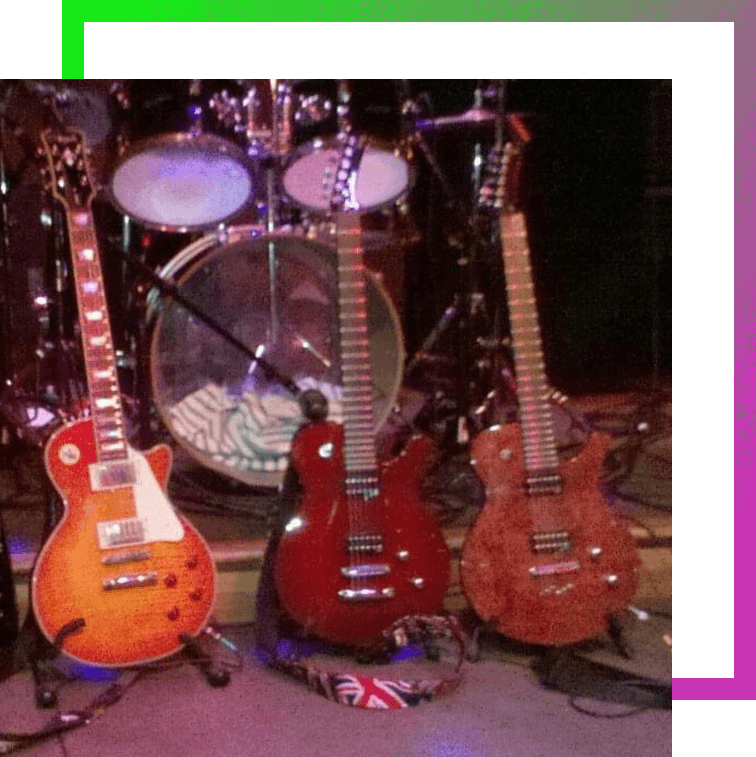
That Christmas my father bought two Norma electric guitars and a Sears amplifier for my two older twin brothers, and a Magnus chord organ for my sister. They bought me a $10 drum set from Halles department store in downtown Cleveland. My brothers didn't know how to play the guitars and my parents couldn't afford lessons. My drum set ended up outside in a rainstorm because I played it too much and drove everyone crazy.
In fifth grade, Sister Mary Judith Ann made me shut up because I was louder than anyone else in the class. Sorry, lol, not my fault.
In the summer of 1967 Mom decided I should take guitar lessons to give me something to do. My teacher, Bill Hoca, never taught chords and I couldn't comprehend the whole scale-theory thing, but I learned to play some notes and tune a guitar somewhat, so there was the foundation. It lasted about six or eight months. Then my father said, you're never going to be anything playing that fiddle, no more lessons.
So I kept at it with what I could get. When I started playing with friends we had no money, no car, no practice place. I used Jensen 6×9 speakers to try to make PA cabinets and got laughed at, but it was all I could afford.
When you saw a guitar you wanted, it started an internal time bomb with an extremely long wick, so I started saving. One day, after my buddy Ed Share got a Gibson Les Paul, I asked my dad to drive me down to Difiore's, which he reluctantly did.
I looked at a Gibson gold top, around $400, and I only had $200. Next was a burgundy Gibson Marauder. So while I was playing the Marauder, which was $300, dad says, is that it? Are you ready? So I said yea, but it's 300 and I only have 200.
Mr. Di comes over and says, you like that. I said yea. My dad said, can you do better on the price? Mr. Di says $250. So dad lets me suffer a bit more, and then he says to Mr. Di, is that the best? Mr. Di replies, yes, I can save you the tax if you have a number. So dad pulls out his wallet for the tax number and, to my surprise, also pulls out a $50 bill. That's how I got my first real guitar, and I still have it.
Losing My Voice
As a local band named Jackal we practiced twice a week, just as new wave, punk and even disco were all starting. We were doing Bowie, Aerosmith, Nazareth, and started learning the Cars. I was into making the band a success. The other members were not.
Our bass player, Kevin Reis, started talking about another band he used to be in, playing in Rocky River on an upcoming Saturday night. I truly disliked the arrogant lead singer but wanted to hear the band — and their lead guitarist, Jim Orth, flew up and down the neck with Van Halen style. I immediately wanted in.
I was soon the lead singer of Wynn Jammer, a little more success than Jackal, but still a revolving door of musicians who always thought the grass was greener elsewhere.
Then my voice started giving me problems. I signed up for voice lessons at Koch School of Music in Rocky River. Norma Codispoti, a mezzo-soprano, became my teacher. After a couple of lessons I brought in a tape recorder with a concert we'd played at Parmatown Mall for a muscular dystrophy benefit.
I stayed after class and asked if she would listen to something. She agreed. I started the tape, and she said, that's pretty good, who's that singing? I replied, it's me. She looked me square in the eyes and said, you have nodes on your vocal cords.
She gave me the name of Dr. Raymond Votypka. He examined me, put that little mirror down my throat, and said I had two options: surgery, which is not guaranteed, or vocal rest, vitamins with zinc, and Robitussin.
I took the rest. A year later, with the training from Ms. Codispoti, I was back.
Trying to Get the Songs Out
A few more years of ups and downs with various forms of Wynd Jammer. The most promising version had Sam and Dave Friedman, Mark Hall, and Mike Roland on keys. We finally thought we were on our way — gigs scheduled, well rehearsed, some steam — when Mark had an accident at work and the first digit of his left index finger was cut off. A few of us waited while he tried desperately to play lead guitar with three fingers. And he did. But others decided to leave anyway, and I got married, and then everything went to shit.
Then in 1988 I got a call from Jim Orth, asking about the whereabouts of a luthier we used to use. Jim and his brother Gary stopped by one day. I played them some songs on my guitar, he left me a tape with some songs on it, and I started writing. Some of the songs I play today start right there.
We made a cassette, eight or nine songs, and had them duplicated. We entered the Denny Sanders theme song contest on 105.7 and lost — we weren't popular enough to get votes or friends to call in. Duplicating a hundred copies was rough, money was rough, and where the hell do you send them anyway. I got a phone book from Manhattan and started mailing to record companies, South by Southwest, radio stations. It was 4-track quality and that hampered it.
There were a few things after that. We played out as a three-piece with a drum machine and a computer running a keyboard, and I got us on the Cox Cable show Cleveland Rock Beat with Mike Matis — we were on TV for a whole month. Then grunge came in, rap was in full gear, disco was dead, and it was back to the roots. Copy bands, 80s bands, another attempt at originals on CD, and another terrible experience.
Band after band, the same list. Somebody's voice would go on the high parts. Somebody would drink the night's pay before we'd been paid it. Somebody would decide the grass was greener, usually right about the time we finally got tight. And at some point somebody would blame me for the band going nowhere — usually whoever had talked me into starting it.
If you've played in bands, you've met all of them. It's the part nobody tells you about. The music is easier to deal with than the band mates.
The thing that didn't change was the itch. Once rock n roll is in the blood, it never leaves.
By 2016 I was playing out a couple of times a month. One night the bass player said, after a gig in July, I'll be leaving at the end of the year. I looked at him and said, sorry, I'm leaving now. I quit. It was the best move I ever made.
Starting Fresh
In 2017 I started redoing the live practice space at my house, turning it into a recording studio by myself, the way I wanted. It's a huge thought process and takes an amazing amount of time, money and equipment. Miles of cables just like every other studio. I cut rectangles into the French doors so I could see from the live room into the studio. No big deal, but I had to do it.
In 2018 I started recording, and it needed something. I recruited Matt Kruger as my engineer. The problem was the sound quality was better, but the songs didn't sound any different from the original versions.
Then the first flood. A leak from upstairs, all over some old keyboards. I survived that one. I kept asking musicians to play. I asked Jim Bonfanti of the Raspberries, who without hesitation said yes, and Norm Isaac of Bluestone Evolution, who graciously was interested too. I asked a lot of others and got nothing. Willing to pay $100–200 for learning a song, I got nothing.
Into 2019, and a few of the mixer tracks failed — nothing recorded, no playback, dead. I hunted down the exact mixer, found one for sale on Facebook, and the guy said he'd deliver. Then flood number two. Same area, different problem, this time over the amplifier wall and a few keyboards. Nothing really important, thank heavens.
So we start up again. Matt coming over to run the board. Brian Baron on drums — the first real drummer I ever had — recording a few songs. Vinnie Cirigliano from my last band playing on another. We were making progress.
The Stroke
Then in April of 2019 I had the weekend off. It was a lazy Saturday. I was playing with my dogs on the floor and brushing them, and I dozed off.
When I woke, everything on my right side was goofy. I thought my arm had fallen asleep or been bitten by a spider. I got up to let the dogs out, running into walls and walking strange. I let them out, sat on the outside steps and had a cigarette.
I kept a plastic gallon jug outside for the butts, but when it came time to put the cigarette in, I couldn't. Still thinking nothing major was wrong, I took it easy until Tuesday morning, when I tried to drive and went to work. As soon as I arrived my brother said, to the hospital you go. They confirmed I had a stroke.
Every word out of my mouth was a stutter. Everything goes through your head. Will I be able to play guitar? Will I be able to sing? How has this affected me?
The recording was on hold for the rest of that year. And then everyone got affected by the coronavirus.
I Can Sing Again
I can sing again. The guitar playing isn't the same.
Frankie Vinci and I friended each other on Facebook somewhere around 2012. Frankie played keyboards and sang in the band Fotomaker. Wally Bryson played guitar in that same band — the Wally Bryson who played lead for the Raspberries, the band that has been my favorite ever since.
We had a few conversations, I'd helped him out with a situation he had, and we became friends. One day he said, why don't you start a Fotomaker page on Facebook. I did, and shortly after that I started the band Artful Dodger's official page too.
Then one day during the pandemic we were talking on the phone, and Frankie said, send me one of your songs and I'll cut the music for you. If you like it, we'll talk. If you don't, no worries.
I have to say that without Matt Kruger running the board — the vocals, drums, bass, guitars, all the mixing, setting up mics on drums and amps — I'd be nowhere near this point. And Frankie is the total producer package. He brought new life to these songs. I don't think there's anything he can't play.
The record came out in 2022. Twenty songs, written across thirty years.
I've got one more show in me, and I'm calling it a farewell.
So. Twenty songs, and I can still sing them. Not bad for a kid whose father told him he'd never be anything playing that fiddle.